

Swamp coolersand your roof
A rooftop swamp cooler leaks from four places: the float valve, a rusted pan, the bleed line, and the seal where the curb meets the roof. The first three are the cooler's, and the last one is a job for flat roof repair.

Is it the cooleror the roof?
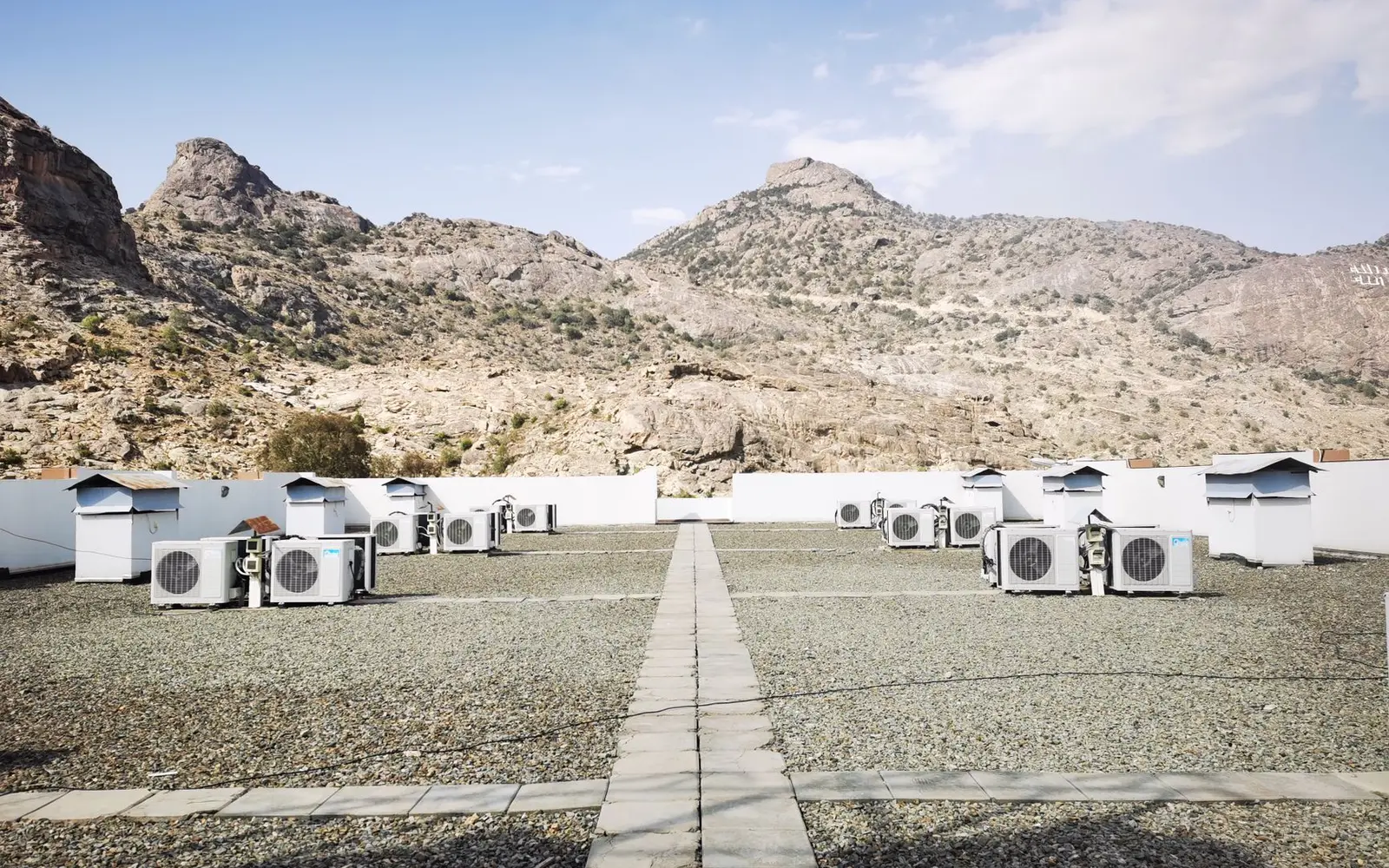
Plenty of El Paso roofs carry a cooler. In 2017, 51.5 percent of El Paso Electric's residential customers in Texas and New Mexico had evaporative cooling.4 That is a lot of roof openings, and every one is a place water can get in.
A float valve set too high lets the pan overflow. Phoenix Manufacturing tells owners to set the float to hold 2 1/2 inches of water in the pan.1 A pan with rust pinholes drips all the time, and a bleed line pointed at the roof soaks it.
Read the timing
A leak that shows up only while the cooler runs tends to be the cooler. A leak that shows up only after rain tends to be the seal at the curb. El Paso gets about 8.78 inches of rain in a year, so a drip in a dry month is hard to blame on the sky.6
Check this first. Shut the cooler off and watch the stain. If it stops growing, look at the float, pan, and bleed line before you call about the roof.
Bleed lines andthe city rule
A bleed line should never drain onto the roof. The Phoenix manual says to avoid draining water onto a roof, because mineral build-up or damage to the roof may occur.1 That white crust on a flat roof is often that mineral build-up.
El Paso's code says the same thing in its own way. New or replacement bleeder lines can be no larger than one eighth inch inside diameter. They must run outside and discharge where the water can feed landscaping or other plants, unless that is impractical.2
Waste from a cooler's automatic draining system goes into the building drain through an indirect waste line, or to landscaping.2 A line that dumps on the roof does not appear to fit either option.
Flashing aroundthe cooler curb
The roof leaks at the curb when its flashing fails. The National Roofing Contractors Association (NRCA) calls faulty flashing one of the major sources of leaks on flat and low-slope roofs, at parapets, penetrations, and pipes.5
NRCA recommends base flashing that rises at least 8 inches above the roof surface.3 A curb whose flashing sits low, or whose seal has cracked in the sun, lets rain run in beside the cooler.
When we inspect a leak, we check the curb flashing and the roof around it along with the cooler. Our roof leak detection finds where the water enters before anything is repaired.
Switching torefrigerated air
When the cooler comes off, the hole in your roof has to be dealt with the same day. A cooler sits on its own jack or curb, and a package AC unit usually needs a different footprint. The usual options are to reuse the curb, fit an adapter, or build a new curb and flash it again. These are typical practice, not a standard.
If you want no unit on the roof at all, the opening is closed instead. On a flat roof that means a patch over the deck and a new roof covering that ties into the old one. Water gets in fastest at the edges of that patch, so it's flashed like any other penetration.
Who patches the roof?
The HVAC company handles the cooler and the new unit. The roof patch is often left out of an HVAC quote, so ask in writing who is doing it.
Lifetime Roofing of El Paso, a family owned roofing company in El Paso since 2019, uses its own crew for roof work, not subcontractors. If a leak comes back on our work, we come back and fix it at no charge.
Where rain gets in,beside the cooler
Questions people askabout cooler leaks
Can my bleed line drain onto the roof?
No. Phoenix Manufacturing's manual says to avoid draining water onto a roof, and El Paso's code sends bleeder lines outside to landscaping. Lifetime Roofing of El Paso inspects the roof side of cooler leaks for free.
How big can a new bleeder line be in El Paso?
One eighth inch. City code limits new or replacement evaporative cooler bleeder lines to one eighth inch inside diameter. Lifetime Roofing of El Paso looks at the roof side only; the cooler itself belongs to your HVAC company.
How high should flashing around a cooler curb be?
At least 8 inches. The National Roofing Contractors Association recommends base flashing at least 8 inches above the roof surface. Lifetime Roofing of El Paso checks that height during a free inspection.
Who patches the roof when I switch to refrigerated air?
Ask before you sign. The roof patch is often left out of an HVAC quote, so get in writing who does it. Lifetime Roofing of El Paso gives a written estimate within 48 hours of the inspection.
Where these factscome from
- Phoenix Manufacturing, Pro-V Series Owner's Manual, read November 1, 2026.
- El Paso Water, 2024 Water Conservation Plan, quoting City of El Paso code Title 18 and Section 18.20.170, read November 1, 2026.
- National Roofing Contractors Association, Is there a maximum flashing height, 1994, read November 1, 2026.
- El Paso Electric, filing in NMPRC Case No. 18-00116-UT, citing its 2017 Residential Appliance Saturation Survey, read November 1, 2026.
- National Roofing Contractors Association, Flashing guidance for low-slope roofs, read November 1, 2026.
- NOAA National Centers for Environmental Information, 1991-2020 Climate Normals, El Paso station, read November 1, 2026.
More fromthe guides
- Flat Roof Ponding Water and Drainage
What ponding water is, why it sits on a flat roof, and what fixes scuppers and parapets
- How to Find a Roof Leak
Why the stain isn't under the leak, and what you can check before calling a roofer.
- Elastomeric Roof Coating: What It Does
What elastomeric roof coating does, and when it hides a leak instead of fixing it
Call Lifetime Roofing of El Paso
 (915) 353-3934
Get a free roof inspection
Based at 8900 Gateway Blvd E, El Paso, TX 79907